

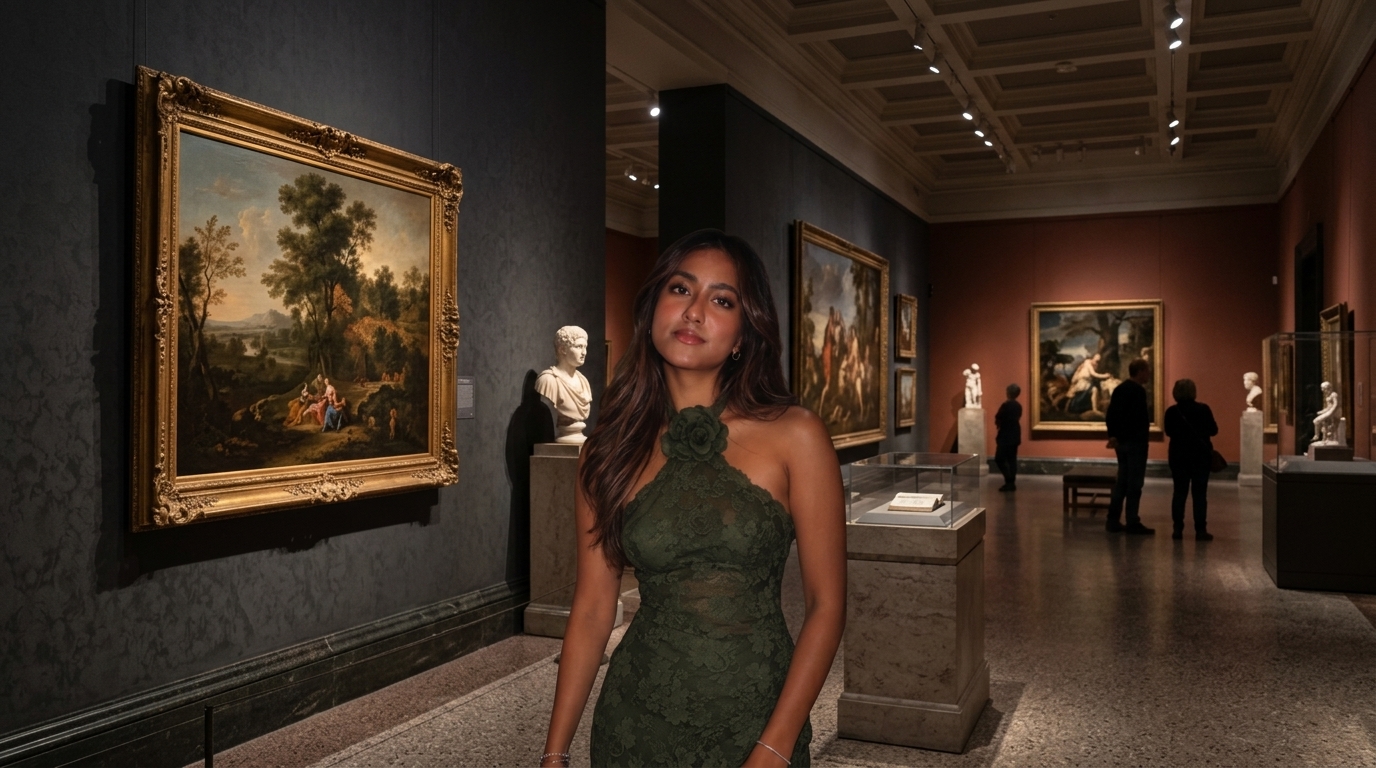
The high school senior does not paint. She reads paintings, and her sharpest find so far is that one of art’s most celebrated movements was quietly put to work in ways many of its own painters may never have fully understood.
Sanjana Divakar was writing a paper for a high school history class when she found the detail that redirected her. It wasn’t in a painting. It was in a footnote. The Abstract Expressionist canvases she chose to research, the same Rothkos and Pollocks that often make their way into the Museum of Modern Art, had in the 1950s been folded into a touring exhibition called “The New American Painting,” sent across major European cities and widely believed to have been organized with backing from the Central Intelligence Agency. “It wasn’t just history,” she says of the discovery. “These were artworks used as propaganda, quietly and (not necessarily with) artists’ support and awareness.”
Sanjana is careful about a distinction most people her age skip past. She is not an artist, and she does not want to be introduced as one. What she has instead is a research paper, written for a history class and expanded since, arguing that Abstract Expressionism was never only a style. It was a language, built by people trying to put words to a war that had just finished taking almost everything from them.
Reading Paintings Like Documents
“I’m not interested in making the work,” Sanjana says. “I’m interested in why it exists, and what happened to it after.” She describes herself as appreciative of art rather than a practitioner of it, drawn to paintings for the history sitting underneath them rather than for the technique on the canvas. It is a small correction, but it matters to her, and it shapes everything she has chosen to study since.
Her paper starts where most survey courses do, with the devastation of the Second World War and the artists who came out the other side of it needing a new way to say what they had seen. Jackson Pollock’s “Number 1A, 1948” is her example of that instinct taken furthest, paint laid on canvas in what he called a performative sequence of gestures rather than planned in advance. Pollock made the underlying point himself a few years earlier, saying it didn’t matter “how the paint is put on, as long as something is said.” Mark Rothko, working in what came to be called Color Field painting, put the same instinct differently in a statement, insisting he cared only about “expressing basic human emotions, tragedy, ecstasy, doom and so on,” a line Sanjana connects directly to his 1953 canvas “No. 61 (Rust and Blue).” Neither man was talking about decorative beauty. Both were talking about getting something true onto a surface that could carry it.
Sanjana’s favorite case study is Adolph Gottlieb’s 1951 painting “Tournament,” now held by the Museum of Modern Art. She reads its fractured, half human shapes as evidence of a generation working out its own dislocation in real time, and she connects that reading to Carl Jung’s writing on the collective unconscious, which several of the period’s painters, Rothko among them, are known to have taken seriously. Her paper also draws the line the survey courses often skip, the one between Pollock’s Action Painting and Hans Hofmann’s theory of visual “push and pull,” and the slower, planar Color Field work Rothko and Barnett Newman were doing at the same time. It is the reading of someone who kept going long after the assignment ended, not someone dabbling in one.
She traces the movement’s roots further back than the war itself, to Wassily Kandinsky, who never left Europe for New York the way so many of his contemporaries did but is still credited as one of the movement’s founding influences for what one source in her bibliography calls “a new pictorial language.” Sanjana reads that detail as proof the movement was never purely American in its origins, whatever role it was later made to play in an argument about American superiority.
The Weapon Inside the Brushstroke
The part of the paper Sanjana wants a wider audience for is the one about what happened next. The Metropolitan Museum of Art’s own history of the movement lays out how central the war and its aftermath are to understanding what these painters were actually doing. What that same history does not dwell on, and what pulled Sanjana in, is the second life the movement lived once the Cold War took an interest in it.
According to the writer and historian Frances Stonor Saunders, whose research Sanjana cites directly, the CIA covertly promoted Abstract Expressionism abroad to argue that American artistic freedom outclassed Soviet restriction, moving the funding through channels designed to keep its source out of view. One widely cited account of the touring exhibition holds that the painters whose work appeared in it were “completely unaware” their canvases had been repurposed as propaganda.
For Sanjana, that is the real story, more than any single canvas. A movement built to process private grief was put to work arguing that American freedom produced better art than Soviet control ever could, largely without the artists themselves controlling how their work was being used to make that case. “I found that upsetting and fascinating at the same time,” she says. “The paintings didn’t change. What people were told to see in them did.”
The government’s interest in the movement did not start with the CIA, and Sanjana’s paper traces the earlier chapter too: Depression-era mural commissions for federal buildings, followed by a postwar surge in private patronage from dealers like Peggy Guggenheim and Betty Parsons that gave the movement its first real momentum.
The Cold War funding she found is a stranger, quieter version of that same governmental interest, working through channels built specifically to stay invisible rather than through an open commission.
Her paper also catches a detail that gives the whole story an edge most people miss. The same government quietly promoting Abstract Expressionism abroad as proof of American freedom was, at the very same moment, branding it un-American and unorthodox at home. Sanjana reads the contradiction as the real proof of the movement’s power. Art dismissed as suspicious in Congress was simultaneously trusted enough to represent the country in Paris and London.
Her paper includes a second case of the American government taking an interest in what its painters were doing, and the two sit oddly next to each other. More than a decade before the CIA’s involvement, the U.S. Navy pulled Paul Cadmus’s 1934 painting “The Fleet’s In!” from public display over its depiction of sailors on shore leave, after a Navy admiral called it, in a letter to the press, “a most disgraceful, sordid, disreputable, drunken brawl.” Sanjana’s paper treats both episodes as the same instinct working in opposite directions, a government willing to suppress the art it found embarrassing and just as willing to quietly deploy the art it found useful.
Learning the Business Side of a Wall Label
Sanjana’s interest in art history has not stayed inside a classroom. She has spent time at an art gallery in Greenwich, Connecticut, working alongside gallery directors and curators on the parts of a gallery’s business that never make it onto a wall label, how a show gets built, how a piece gets priced, how a director talks about a painting to someone deciding whether to buy it. It is the side of the art world she says she actually wants a career in, closer to a curator’s desk than an easel.
That instinct is consistent with the goal she names most directly. Asked where she wants to be in five years, she doesn’t hesitate. She wants to be doing sales and curation work inside a major museum or gallery, somewhere on the scale of the Metropolitan Museum of Art in New York. It is a specific answer from someone who has already spent real hours inside a gallery finding out whether she likes that work, rather than assuming she would.
She has also gone looking for that answer outside Greenwich. She attended Vogue Summer School at the Condé Nast College of Fashion & Design, and a social psychology program through Columbia University’s School of Professional Studies built around how people actually form judgments, including, she suspects, judgments about what belongs on a museum wall. Neither program is about painting. Both are about the systems that decide what gets shown, which is where she keeps saying she wants to end up.
Building a Different Kind of Gallery
That hands-on year is already shaping something of her own. Sanjana is building a portfolio of artists working in variations of Abstract Expressionism, deliberately niche and often tied to a single region rather than a global market, and she is looking for a specific kind of fit with each one, art that carries a meaning or a story through symbol or through restraint, without the visual noise that can crowd out either.
Alongside that search, she is developing a website that uses augmented reality, built with the help of artificial intelligence, to let a viewer see a painting on their own wall at its true size and color before they ever buy it, a tool aimed at buyers and enthusiasts anywhere in the world who cannot stand in front of the work itself. The technology is already built. What she is working on now is finding the artists whose work belongs inside it.
The Argument Behind the Application
Sanjana is applying to art history programs in the United States, the United Kingdom, and continental Europe, and the paper on Abstract Expressionism and its Cold War afterlife is the piece of work she wants those programs to read first. It is easy to see why. A tenth grader who goes looking for a footnote and comes back with an argument about a nation’s own painters being turned into an argument for its politics is doing the kind of reading a graduate program looks for, not the kind a high school rubric requires.
What makes her application unusual is less the paper by itself than the combination around it. Most seventeen and eighteen-year-olds applying to art history programs arrive with a studio portfolio and a stated appreciation for a period or a painter. Sanjana is arriving with a piece of original archival argument, a season spent on the working side of a commercial gallery, experience at a local museum, and programs built around how institutions and audiences actually form judgments about culture. None of it guarantees anything about where she ends up. Together, it reads as a fairly specific answer to which part of the art world she wants to spend her career in, arrived at well before most people her age have to choose.
She also closes her paper somewhere most high school papers do not go, with Ai Weiwei’s 2017 installation “Law of the Journey,” a giant inflatable boat built from the same refugee crisis the artist has spent years documenting. The connection Sanjana draws runs through habit rather than movement. Both Ai Weiwei and the postwar painters were trying to put a shared, unbearable feeling into a form other people could stand in front of, and she argues that habit never really went away, seventy years apart.
What she is not claiming is that she has finished the argument. Her own account of the Cold War funding leaves real questions open, including how much any individual painter understood about where support for their work was actually coming from, and Sanjana treats that gap as something still worth researching rather than a detail to smooth over. That is a historian’s instinct, not a painter’s, and it is the instinct shaping where she wants to spend the next several years.
She is a high school senior who has never sold a painting and does not plan to start. What she has is a footnote she refused to let go of, and a fairly exact idea of which side of the museum wall she wants to be standing on. Most people her age have neither.