

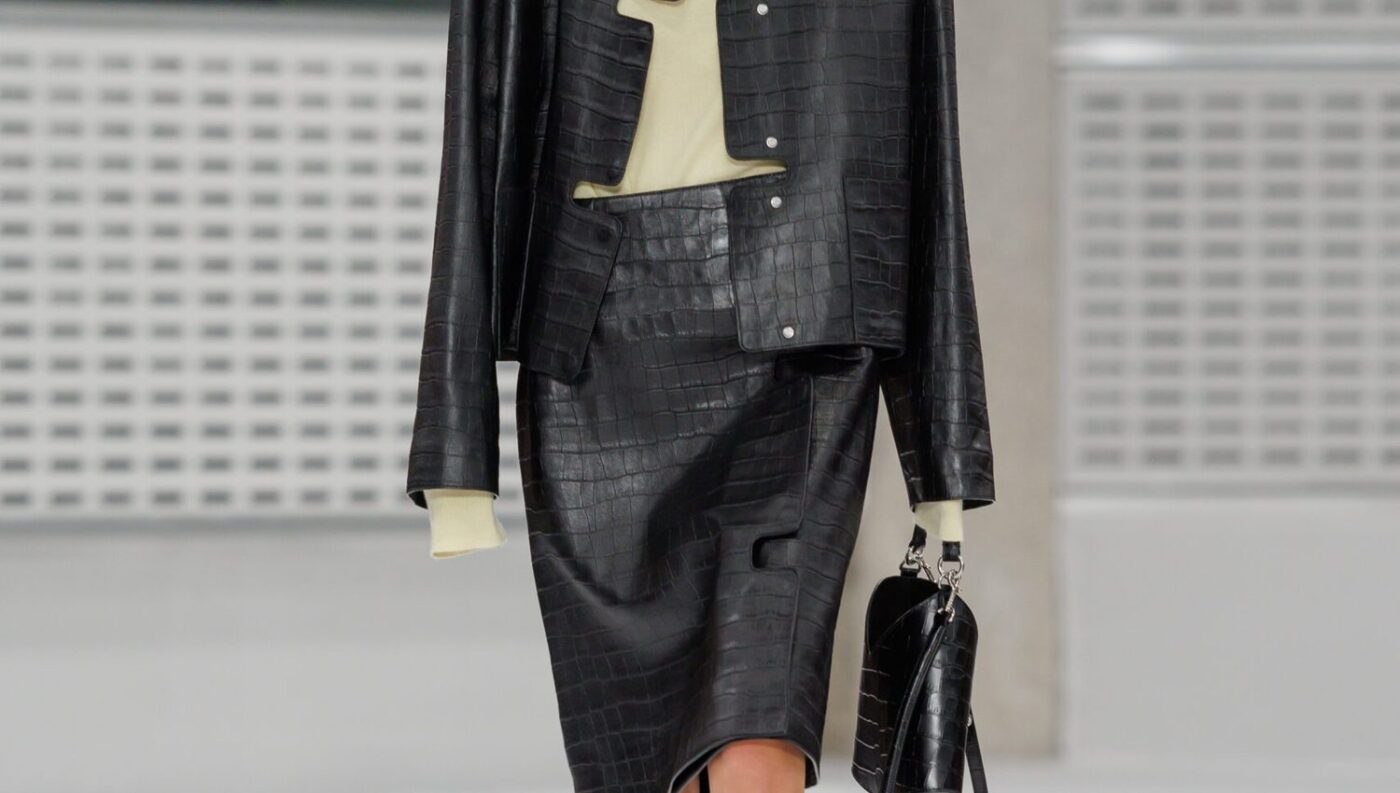
Christopher Kane presented his first collection as creative director of women’s ready-to-wear at Mulberry on Sunday afternoon, his first public appearance since the British designer was appointed to the role in March. The show, staged during London Fashion Week’s spring/summer 2027 season, returned the leather goods house to the runway and marked Kane’s own return to fashion after a break of about three years. It also gave one of Mulberry’s most significant recent hires a first public chance to set out his direction for the brand.
Kane developed the collection with his sister and longtime collaborator Tammy Kane, building it around contrasts the pair associate with British culture: establishment and subculture, the precious and the practical, nature and industry. Rather than treating Mulberry’s handbags as accessories alone, they reworked the house’s most recognisable designs into clothing. The stated aim was to communicate the brand through construction and detail rather than visible logos, letting the shapes of familiar products carry the identity instead.
The clearest example was a white leather dress cut with horizontal geometric tiers that echoed the flap of the Bayswater bag. The crenellated Bayswater silhouette reappeared across outerwear, tailoring and knitwear, while the Postman’s Lock closure was translated onto belts and footwear. Kane also drew on his own history, recreating a 1990s Mulberry sweatshirt tied to the football casual culture of his hometown.
Accessories followed the same logic. The designer introduced axe-shaped mirrored heels and a shoulder bag named the Chop, a reference to the logging heritage of Somerset, where Mulberry was founded in 1971. The wider palette leaned toward muted tones and pared-back silhouettes grounded in the brand’s leather craft. The collection is scheduled to reach stores and go online in January 2027.
The appointment places one of London’s most closely watched designers at a heritage label looking to sharpen its identity. Kane launched his own line in the mid-2000s and built a reputation for combining industrial references with couture technique before the business closed. His arrival at Mulberry gives him a larger platform and ties the brand’s next phase to a name long associated with British fashion’s experimental edge.