

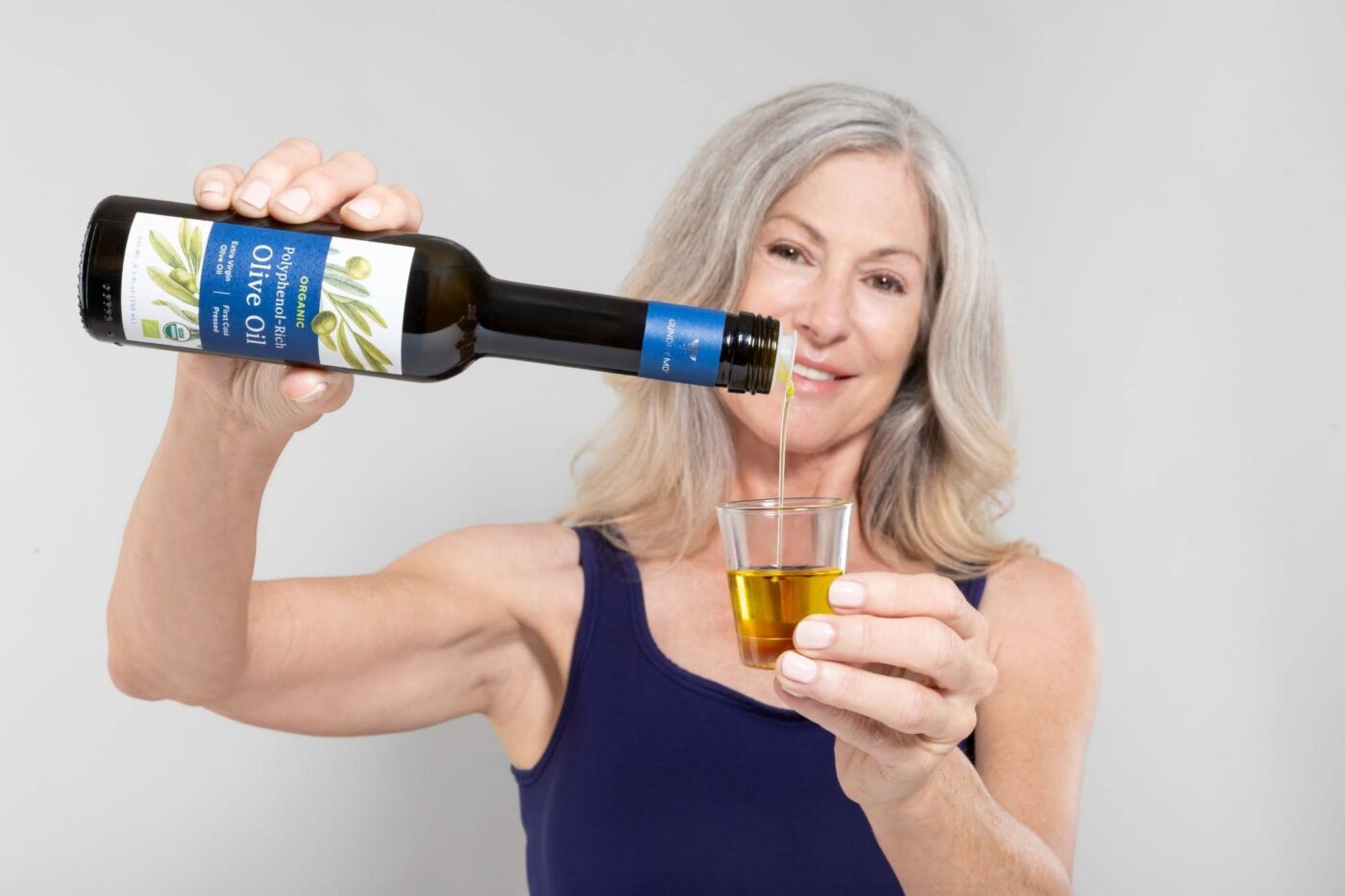
A spoonful of olive oil every morning is the wellness habit of the moment. Here is what makes it worth doing, and why the oil you choose makes all the difference.
A tablespoon of olive oil, taken straight, has become one of the more unlikely morning habits of the past few years. People drink it neat or with a squeeze of lemon before breakfast, and a good number of them film it for social media. The habit only makes sense if the oil is worth drinking on its own, and that comes down to polyphenols, the plant compounds that give a good extra virgin olive oil its bitterness and its peppery bite. Steven Gundry M.D. was making that argument well before the olive oil shot had a hashtag.
Why Is Everyone Shooting Olive Oil?
Part of the appeal is simplicity. An olive oil shot needs no equipment and takes seconds. The other part is that it skips the stove. Olive oil is usually cooked, mixed into dressing or poured over food, and a shot is the one way to get it exactly as it leaves the bottle.
Dr. Gundry, the former cardiothoracic surgeon behind health brand Gundry MD, was recommending a daily shot of olive oil to his patients years before it became a social media ritual, and he promoted the habit on The Dr. Gundry Podcast in 2019. In 2021, Gundry MD went further and established National Polyphenol Day on July 11. Its signature way to celebrate is an olive oil shot.
The shot also changes what you want from the oil. A mild, buttery oil that disappears into a salad has nothing to offer when you drink it neat. The oils worth shooting are the ones with something to taste.
What Gives Good Olive Oil Its Bitter Bite?
In 1999, the American scientist Gary Beauchamp tasted freshly pressed olive oil at a meeting in Sicily and noticed a sting at the back of his throat. His team traced the sensation to a compound they named oleocanthal and published the finding in Nature.
Oleocanthal is one of a family of olive polyphenols that also includes hydroxytyrosol and oleuropein. Oleuropein is the reason a green olive picked straight from the tree is too bitter to eat, and why table olives have to be cured. In oil, these compounds show up as bitterness on the tongue and pepper in the throat.
The professionals treat those sensations as good news. The International Olive Council, the intergovernmental body that sets quality standards for the trade, lists only three positive attributes in its official tasting method. One is fruity. The other two are bitter and pungent, a “biting tactile sensation” felt “particularly in the throat.”
Dr. Gundry put it in four words in The Plant Paradox in 2017. “More bitter, more better.” Two years later, in The Longevity Paradox, he spelled out why. “Olive oil’s main fat is monounsaturated fat, oleic acid, but it’s not this fat that makes olive oil healthy,” he wrote. “It’s actually all the polyphenols that are contained in olive oil that make the difference.”
What Are Polyphenols, in Plain English?
Polyphenols are natural compounds that plants make to protect themselves. They are found in many everyday foods, including olives, berries, tea, coffee, and dark chocolate, and more than 8,000 different kinds have been identified. In olives, they are what make the raw fruit so bitter.
When olives are pressed, some of those polyphenols carry over into the oil. How much makes it depends on the olives, when they were picked, how they were pressed, and how the oil was stored. Two bottles that both say “extra virgin” can be very different on the inside, and the label on the front usually won’t tell you which is which.
Why High Polyphenol Olive Oil Matters if You Take Olive Oil Shots
If you are going to take olive oil straight, the polyphenols are the reason to do it. A shot is only a tablespoon or so, which means the amount of polyphenols you get comes down entirely to the oil in the spoon. A low-polyphenol oil gives you a spoonful of fat and not much else. A high-polyphenol olive oil gives you the compounds the whole habit is built around.
That is why the taste test matters. A bland olive oil is often a low-polyphenol olive oil. If an oil is smooth and mild with no catch at the back of your throat, it probably isn’t carrying much. The pepper and bitterness are the signs to look for. Refined and “light” olive oils go through extra processing that strips out most of their polyphenols, so they are the wrong choice for a shot, however easy they are to swallow.
How the oil is made also plays a part, starting with the harvest. A 2026 study of virgin olive oils from Extremadura in Spain, published in the journal Agriculture, found that phenolic compounds “markedly decreased” as the olives ripened, and linked stronger bitterness and pungency to early-harvest oil. Processing matters too. Cold pressing, prompt bottling, and dark glass all help an oil keep what it started with, and heat works against it, which is another reason a shot is a good way to take a polyphenol-rich oil.
A quick checklist for choosing an oil to shoot:
- It says extra virgin on the label
- It comes in dark glass or a tin
- It tastes bitter and peppery, not buttery
- The producer publishes a tested polyphenol number
What Is Gundry MD Polyphenol-Rich Olive Oil?
Gundry MD Polyphenol-Rich Olive Oil is an extra virgin olive oil that Dr. Gundry designed specifically for the daily shot. It is single-origin, made only from olives grown in harsh desert groves in Morocco. Gundry MD’s explanation is that the stressful climate triggers a nutrient surge in the fruit, concentrating polyphenols such as hydroxytyrosol.
The oil is third-party tested at 1,170 mg/kg total polyphenols, using the HPLC method, which is the gold standard of the International Olive Council (IOC).† The analysis was carried out by Eurofins through Eurofins Central Analytical Laboratories, a laboratory recognized by the International Olive Council. It is USDA Organic, first press, cold-pressed, and extra virgin, with no additives, no preservatives, and no harsh chemicals. It is also lectin-free and contains no sugar, soy, dairy, or artificial sweeteners. Researchers at Canada’s University of Sherbrooke have studied high-polyphenol, desert-grown Moroccan olive oil in small trials of older adults, including a 26-week study of antioxidant activity and a six-month study using PET/CT imaging of the arteries. As part of a daily routine, Gundry MD says its oil can help support heart health.*
Expect it to taste as it means it. Gundry MD describes the flavor as bold, peppery, and slightly bitter, with a light tickle in the throat, which by now should sound familiar.
What Olive Oil Benefits Can Gundry MD Polyphenol-Rich Olive Oil Support?
As part of a daily routine, Gundry MD says its olive oil can help support heart health and healthy blood flow,* comfortable joints and muscles,* soft, hydrated skin,* immune health,* healthy energy levels and muscle strength,* clear concentration* and a slim, healthy physique.*
Dr. Gundry’s own summary of his priorities is characteristically blunt. “The only purpose of food is to get more olive oil into your mouth,” he wrote in The Energy Paradox in 2021.
What Do Gundry MD Olive Oil Reviews Say?
Customer reviews tend to return to a few themes. Reviewers repeatedly mention fewer cravings and naturally choose smaller portions. One skeptical first-timer said the taste was smoother than she expected and that she now enjoys it. Another said she looks forward to her morning tablespoon and reports steadier energy.
All individuals are unique. Your results can and will vary.
How Do You Take an Olive Oil Shot?
Gundry MD suggests one or more tablespoons a day. Take it straight from the spoon or pour into a shot glass with a little lemon juice, ideally at the same time each day so it becomes a habit.
If a shot is not for you, the oil works just as well as a finishing oil. Drizzle it over soup or vegetables after cooking, whisk it into a balsamic and Dijon dressing, blend it into a chocolate smoothie or coffee, or stir it through pesto. Avoid high-heat cooking, which can reduce polyphenol content. Store the bottle somewhere cool and dark and finish it within a few months of opening.
What Are the Pros and Cons?
Pros
- Third-party tested at 1,170 mg/kg total polyphenols†
- Single-origin, desert-grown Moroccan olives
- USDA Organic, first cold-pressed extra virgin olive oil with no additives
- Designed to be taken straight, with a 90-day money-back guarantee
Cons
- The bitter, peppery taste is strong and takes some getting used to
- It costs more than a supermarket olive oil
- It is meant for shots and finishing, not high-heat cooking
- Results vary from person to person
Where Can You Buy Gundry MD Olive Oil, and Is There a Coupon?
Buy it from the official Gundry MD website, or on Amazon only when it is sold through the Gundry MD store and fulfilled by Amazon. Listings on other third-party sites may be counterfeit or out of date and do not carry the company’s guarantee. Every authentic purchase is covered by a 90-day money-back guarantee. For discounts and Gundry MD coupon codes, sign up for a complimentary MyAccount at GundryMD.com.
Frequently Asked Questions
1. Why does Gundry MD olive oil taste bitter? The bitterness and the peppery catch in the throat come from polyphenols such as oleuropein, hydroxytyrosol, and oleocanthal. The International Olive Council lists bitterness and pungency as positive qualities in extra virgin olive oil.
2. How much should I take each day? Gundry MD suggests one or more tablespoons daily, straight or with lemon juice.
3. Can I cook with it? It is best used as a finishing oil or taken as a shot. High heat can reduce its polyphenols.
4. Is it organic? Yes. It is USDA Organic, first cold-pressed extra virgin olive oil.
5. Is it lectin-free? Yes. It is also free of sugar, soy, dairy and artificial sweeteners.
6. How should I store it? Keep it somewhere cool and dark, away from the stove, and use it within a few months of opening.
7. What if it isn’t right for me? Gundry MD offers a 90-day money-back guarantee.
† Up to 1,170 mg/kg total polyphenols. Based on a Eurofins lab test completed in September 2026.
* These statements have not been evaluated by the Food and Drug Administration (FDA). This product is not intended to diagnose, treat, cure, or prevent any disease.