

“The industry keeps chasing the next material, the next trend, the next technology — and all of that matters. But what gets lost in that race is the question of whether a piece of furniture will still feel relevant in twenty years. That’s the conversation I think we should be having more of right now.” — Anthony Spon-Smith, Founder & Creative Director, Emrik
A Brand That Refuses to Be Temporary
There is something almost contrarian about showing up to the world’s most frenetic trade fair and insisting, quietly but firmly, that good design is not a trend. Anthony Spon-Smith did exactly that at IFEX 2026, the Indonesia International Furniture Expo, held this March at the newly expanded ICE BSD City in Tangerang — and it worked.
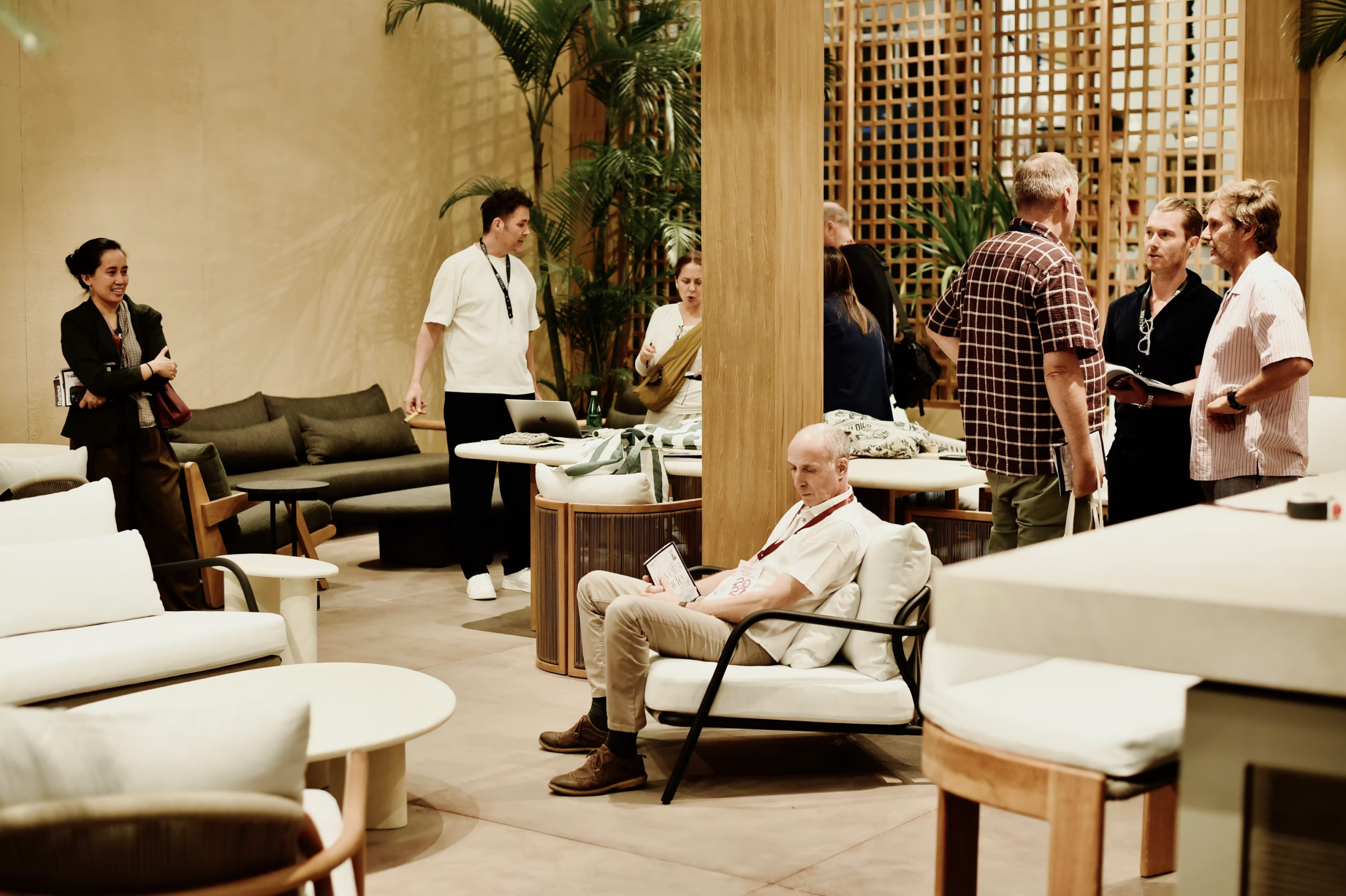
Spon-Smith is the Founder and Creative Director of Emrik, an outdoor furniture brand headquartered in Semarang, Central Java, whose philosophy could be distilled to two words from its own manifesto: Tomorrow’s Classics. In an industry drowning in fast finishes, algorithmic palettes, and modular everything, Emrik walked into IFEX 2026’s 85,000 square metres of exhibition space with something that felt almost radical — restraint with purpose. The brand’s booth drew thousands of visitors over the four-day event, marking what the company called, without apparent exaggeration, its best show yet.

IFEX at Its Most Ambitious
After a decade of showcasing Indonesia’s furniture and craft products, IFEX returned in 2026 with a new exhibition concept, moving to a larger venue at the Indonesia Convention Exhibition (ICE), BSD City, and expanding its scale across 11 halls equipped with modern facilities. The trade show drew approximately 12,000 visitors and featured around 500 exhibitors, making it one of the most significant gatherings in Southeast Asian furniture design. IFEX plays a significant role in reinforcing Indonesia’s position as one of the region’s leading hubs for natural furniture production, particularly in teak, rattan, and bamboo.
For a brand like Emrik — design-led, export-oriented, and rooted in craft — there are few better stages. Spon-Smith, who brings more than 25 years of industry experience to every collection he produces, has made IFEX a cornerstone of Emrik’s commercial calendar. The show is not simply a marketplace. It is, he suggests, a kind of annual reckoning. “IFEX forces you to be honest,” he said during the show. “You can’t hide behind a campaign or a mood board. You stand next to your product, and buyers decide in the first thirty seconds whether you understand what they need.”
The Market Behind the Momentum
To understand why Emrik’s IFEX performance matters, it helps to understand the scale of the arena it is competing in. The global outdoor furniture market was valued at USD 56 billion in 2025 and is projected to grow from USD 58.91 billion in 2026 to USD 92.08 billion by 2034, exhibiting a compound annual growth rate of 5.74% during the forecast period. Asia Pacific dominated the outdoor furniture market with a 45.49% market share in 2025 — a figure that underscores the strategic significance of Emrik’s Indonesian manufacturing base and regional positioning.
The demand signals are equally compelling on the commercial side. Strong demand from the hospitality sector, particularly in resorts and restaurants that emphasize outdoor seating and décor, has been a key driver of the market’s expansion. This is territory Emrik knows well. The brand supplies hotels and resorts alongside premium retailers, and its design language — architectural, enduring, customizable by finish and material — is calibrated precisely for clients who need furniture that performs across seasons, climates, and interior visions.

Design First. Always.
Emrik’s core proposition has never wavered since Spon-Smith launched the brand: everything is designed in-house, by him. The collection, conceived with what he calls “decades of experience and skill” from his wider team, is built to serve some of the best retailers in the world — a claim borne out by the brand’s growing global footprint and its listing on Archiproducts, the international platform for design and architecture.
Outdoor seating furniture is projected to lead the market with a 32.4% share in 2025, driven by its essential role in residential and commercial exterior layouts. Versatility — ranging from lounge chairs and benches to sectional sofas — has made seating central to the outdoor living trend. Emrik’s collection leans into exactly this versatility. The brand’s pieces are not decorative gestures; they are considered solutions, designed to anchor spaces rather than merely occupy them.
Wood is anticipated to hold the leading material share at 28.7% in 2025, owing to its timeless aesthetic, structural strength, and sustainability appeal. Natural wood varieties such as teak, eucalyptus, and acacia are popular for their weather resistance and organic look, aligning with modern outdoor aesthetics. For Emrik, this is less trend report and more confirmation of a long-held conviction. Indonesia’s teak and craft traditions are not backdrop — they are foundation.
The Question of Authenticity
Not everyone in the industry is persuaded that heritage and craftsmanship alone can sustain a brand’s competitive edge as the outdoor furniture market scales rapidly and global players consolidate. One European retail buyer, who asked not to be named, offered a measured skepticism after walking IFEX’s halls. “There are dozens of Indonesian manufacturers producing excellent outdoor furniture, many of them at lower price points than the boutique players,” she observed. “The question is always whether the premium is justified by the design alone, or whether there is a story supporting it that buyers can actually sell to their customers.”
It is a fair challenge — and one Spon-Smith appears to have considered carefully. The brand’s expansion into an interior collection, teased on its website as “coming soon,” suggests an awareness that resting on a single category, however well-executed, carries risk. Outdoor spaces are increasingly being reimagined as extensions of indoor living areas, driving demand for stylish yet practical furniture solutions that bridge the two environments. An Emrik interior line would position the brand to follow the consumer wherever the boundary between inside and outside continues to blur.

Sustainability and the Stakes of the Moment
Manufacturers are embracing environmentally friendly materials, adaptable modular designs, and robust omnichannel distribution strategies, while continuing to invest in resort facilities, rooftop amenities, and outdoor-living upgrades, which are supporting strong commercial demand. These are not merely market trends — they are the new ante for any furniture brand that wants to remain credible in the rooms where procurement decisions are made.
Emrik maintains a dedicated sustainability strand to its brand identity, a signal to retailers and hospitality clients that the ethical provenance of its materials is not an afterthought. In May 2025, the American Society of Landscape Architects announced the approval of new regulations encouraging the use of sustainable materials in outdoor furniture manufacturing, expected to boost demand for eco-friendly products. For brands embedded in Indonesia’s craft tradition — where responsible sourcing of teak and rattan is both a regulatory and reputational imperative — sustainability is less a pivot than a point of origin.
What ‘Best Show Yet’ Actually Means
Trade show superlatives are common currency. “Best show yet” is the furniture industry’s equivalent of a standing ovation — reflexive, expected, and frequently hollow. At IFEX 2026, the phrase carried enough visible evidence to give it weight. Thousands of visitors came through Emrik’s presentation over four days. New releases landed. The brand’s film documentation of the show — sleek, considered, more editorial than commercial — circulated widely enough to extend the reach of the stand well beyond the halls of ICE BSD City.
“We went to IFEX knowing we had the strongest collection we have ever shown,” Spon-Smith said. “But ‘best show yet’ isn’t just about the product. It’s about the conversations. The right buyers, asking the right questions, genuinely engaging with what we’re building. That tells you something about where the market is going — and whether you’re ahead of it or behind it.”
A Final Observation
Standing at the intersection of craft heritage and global commercial ambition, Emrik is a brand in the middle of its own most interesting chapter. The trajectory — from regional manufacturer to internationally recognized design house, with an interior line on the horizon and an IFEX showing that drew genuine industry attention — is real. Whether it can sustain the distinction that makes it worth covering, in a market that rewards volume as readily as vision, is the more complicated question.
“I’ve been in this industry long enough to see what happens to brands that start chasing the market instead of leading it,” Spon-Smith said, with the measured calm of someone who has genuinely thought it through. “The plan has always been the same. Make the best furniture we can. Do it with integrity. Let the work speak.”
At IFEX 2026, the work was speaking clearly. The room was listening.