
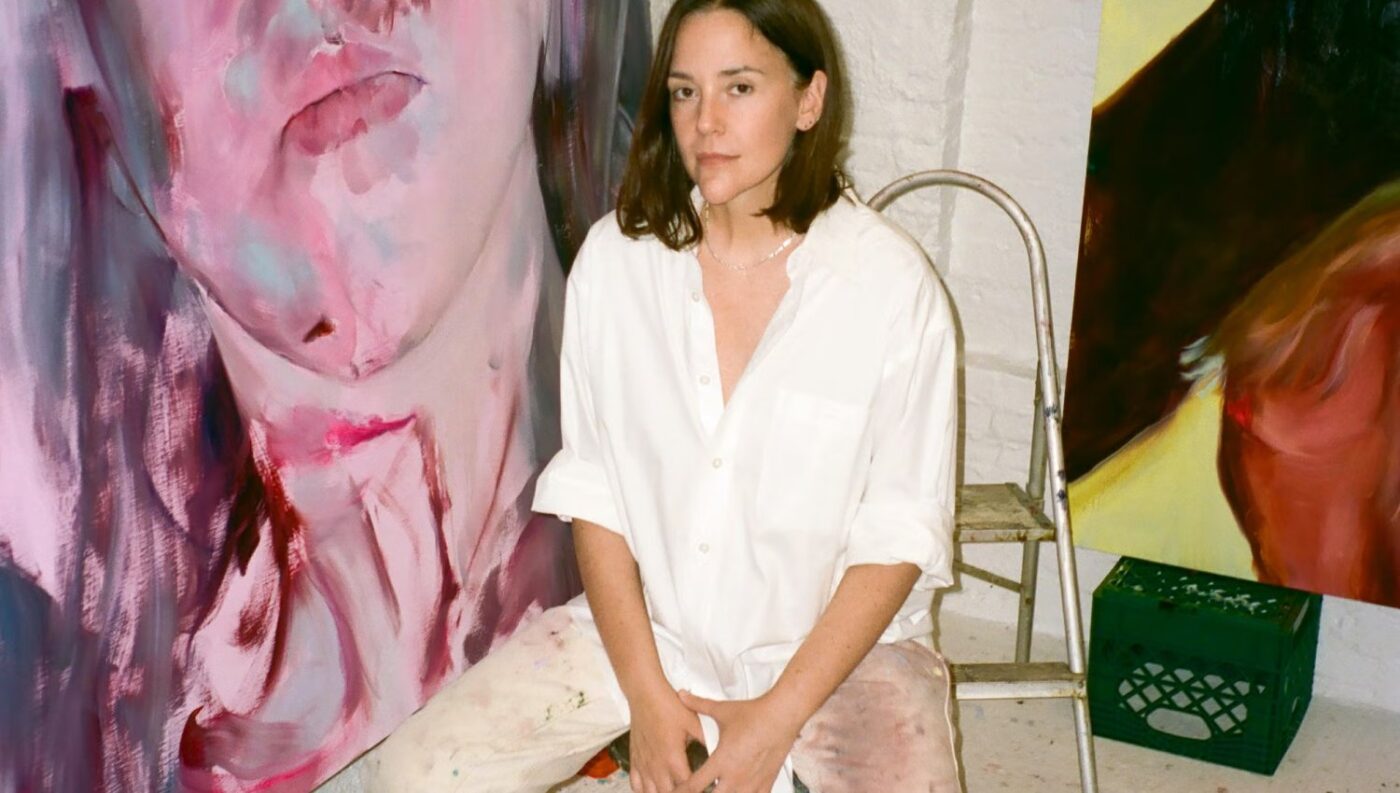
Tucked behind a garden in Bed-Stuy, Brooklyn, Jenna Gribbon’s studio emerges like a cottage out of a storybook, a humble and charming space with exposed beams, whitewashed brick walls and natural light. It fills quickly with her paintings, which range from postcard to Volkswagen Beetle in size. “It’s not always the perfect setup, but I’m able to make it work,” the artist, 47, says, noting that a five-minute walk from her house matters more to her than more square footage. Paint covers every surface, including a dot of blue pigment on her ear.
The studio has been largely cleared in anticipation of her first major solo museum exhibition, opening August 19 at Brandeis University’s Rose Art Museum. “Jenna Gribbon: Entwined” traces her evolution from 2001 to 2026 and suggests that intimacy, whether physical or emotional, performative or earnest, sits at the core of her practice.
“The importance of connection is what the show is about, and what my work has been about for a long time,” Gribbon says. “It’s the reason I’m a figurative painter.” Her portraits of loved ones, rendered in thick, impressionistic brushstrokes, complicate the relationship between subject, viewer and artist. The feedback loop of the gaze, the question of who is really doing the watching, creates a sense of self-conscious observation.
“I have a voyeuristic streak, not in a sexual way, but I love observing,” she says. “Sometimes I forget that I can be seen looking, as if I’m somehow invisible.” Her partner, the musician Mackenzie Scott, is a recurring presence, including in a 2023 canvas playfully titled I Am the Dog, in which a dog stares intently at the subject from the foreground.
The result is a body of work that treats looking itself as its true subject. By turning the tables on the viewer, Gribbon asks her audience to notice their own role in the exchange, a quietly disarming proposition that the Rose Art Museum survey now presents across a quarter century of her career.