
For all the novelty of the term, the pursuit behind “looksmaxxing” is ancient. Women have spent generations chasing physical perfection through makeup, dieting and, more recently, cosmetic surgery, all to meet prevailing standards of beauty. The genuine shift is that men have now embraced the same obsessive routines, and are broadcasting them openly and to equally extreme degrees.
The aim of looksmaxxing is self-improvement, but stripped of anything that reads as feminine. Instead of admitting they are copying rituals women have endured for decades, looksmaxxers repackage their anxieties as problems to be solved through “science” and structured systems. Wondering whether you’re attractive? No need to speculate: measure your canthal tilt, your interpupillary distance, your midface ratio. Slot yourself into a rating framework such as the eight-point PSL scale, which files men into tiers, then follow prescriptions for boosting your so-called sexual market value, maybe through “Zygopush” facial workouts.
By leaning on aggressively masculine phrasing, market-style metaphors, dubious science and a taste for unregulated or fringe methods, men work to separate themselves from anything “culturally coded as feminine, and therefore ‘vain’ and ‘frivolous,'” as Brynn Valentine put it in a recent Dazed piece. They recast the urge to “correct” their flaws as a sober clinical mission rather than a shallow wish to look better. In this framing, being unattractive turns into a kind of moral defect demanding correction by whatever means available, even ones as alarming as using meth for weight loss or injecting dissolvable collagen threads. The stated purpose isn’t confidence or even attracting a partner, but engineering an optimised human specimen. “When you actually know the objective measurements, it doesn’t become about sexual attraction; it’s about mathematics,” one figure known as Clavicular claimed on a podcast.
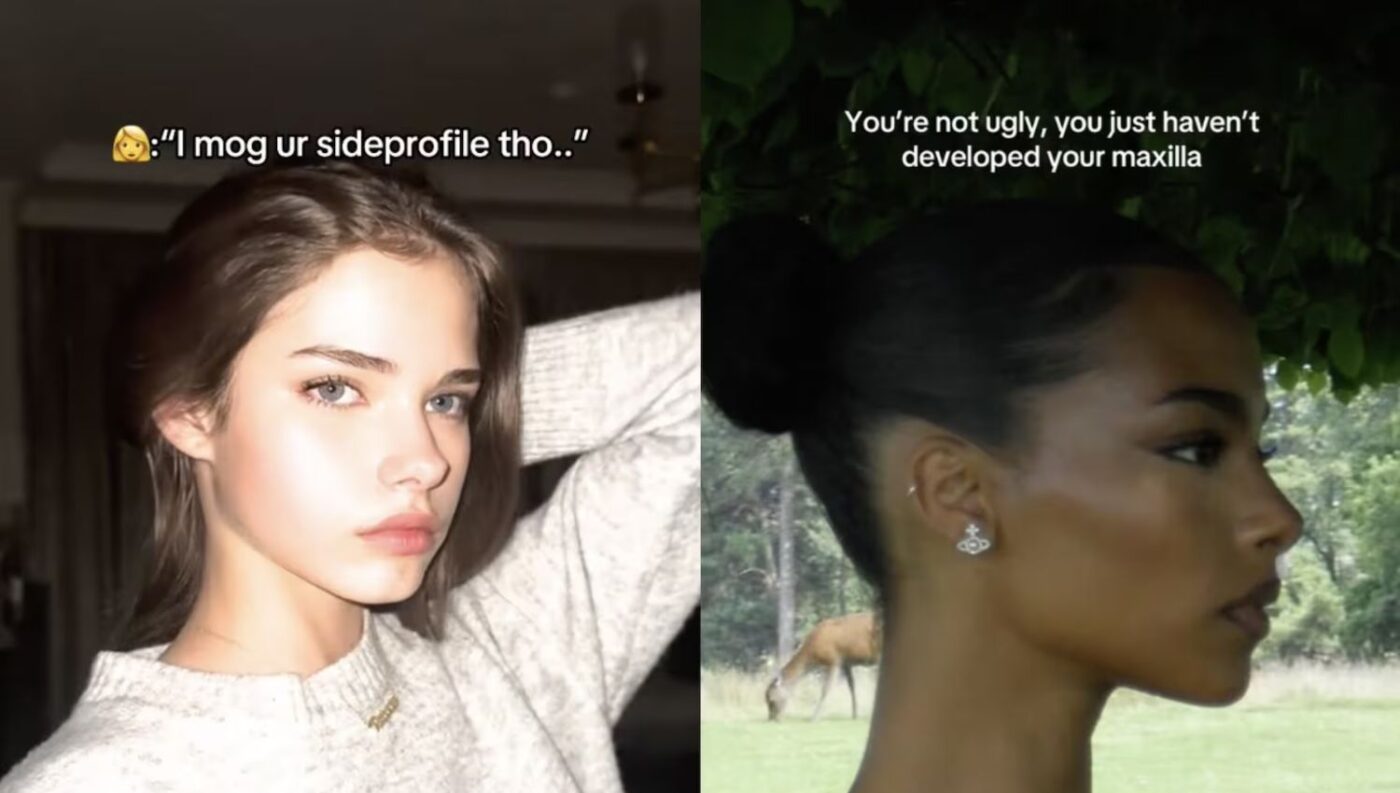
Men essentially rebranded existing beauty work along with its jargon. And although looksmaxxing emerged from the manosphere, it has spilled into the mainstream and is now being marketed back to, and picked up by, women. They may not be striking their faces with hammers to reshape bone (not yet, anyway), but the warning signs are surfacing. Feeds and Discord servers now brim with women demonstrating exercises meant to tone the orbicularis oculi (the eye muscles) or counter a recessed maxilla (the upper facial bone spanning the jaw, cheeks and under-eyes). Some trade advice on “corsetmaxxing.” Others slip into unsettling, quasi-eugenicist talk, boasting about phenotypes as a coded way of referencing whiteness. Even the self-appointed “pick-me” archetype has a new script; less “here’s why girls hate me,” more “I mog your side profile tho.”
Mala, a 26-year-old TikTok creator, began experimenting with looksmaxxing content and vocabulary hoping to be regarded “more seriously” within the beauty world. “I have no problem with men enhancing their looks; it’s natural to seek validation and admiration in that department, but why are women being treated so poorly for wanting those same things?” she says. “When women care about their beauty, they are shallow and stupid, but if a man does, it’s self-care and improvement. Looksmaxxing is men once again taking over women’s spaces and claiming to have discovered them while also actively trying to kick us out.”
Recognising that concerns framed as medical conditions attract more respect than ordinary vanity, women have started wrapping their beauty routines in clinical, scientific-sounding language. A vlog about lip filler might be brushed off as trivial, yet facial exercises to strengthen the maxilla can be made to sound like a health necessity. Given that, the drift toward “masculine” phrasing is unsurprising. “It’s interesting to see what gets deemed as vanity and what gets lauded as biohacking,” says Ellen Atlanta, beauty critic and author of Pixel Flesh: How Toxic Beauty Culture Harms Women. She points to anti-ageing, which was reframed as longevity science once men such as Bryan Johnson entered the conversation.
“It’s understandable why women would want to take on this language but it’s a strange bargain because it concedes that beauty work only becomes serious when it stops sounding like something women do. The labour hasn’t changed. And most people can’t actually afford to do the more scientific or experimental treatments.”
Dr Jordan Foster, an assistant professor in the Sociology Department at MacEwan University, agrees that adopting looksmaxxing language is a “strategically wise” move for women. “It may be a shortcut for women who have always commented on beauty, but whose dialogue has gone without notice until now,” he says. Until quite recently, beauty was treated as strictly women’s territory and dismissed as trivial. “I think it is important to recognise that matters related to femininity are often dismissed as silly. For evidence of this, you can look to a range of women’s health issues that have been neglected by the press, by members of the public and by physicians and researchers alike. Beauty is not so different,” he says.
There’s no correct way to feel inadequate about yourself. The scene in Mean Girls where the Plastics tear apart their own reflections wouldn’t land any differently if one of them lamented a long philtrum instead of a hairline. The trouble is that this linguistic shift lends legitimacy to the more clinical, faintly dystopian manner in which men now discuss their appearance. Borrowing this tech-bro vocabulary to describe our own bodies risks cementing the notion that women must behave more like men to earn credibility. Vanity turns into optimisation, insecurity becomes diagnosis, and beauty is downgraded to just another problem awaiting a fix. The wording has evolved, but the underlying command hasn’t budged: find every supposed flaw, then eliminate it.