

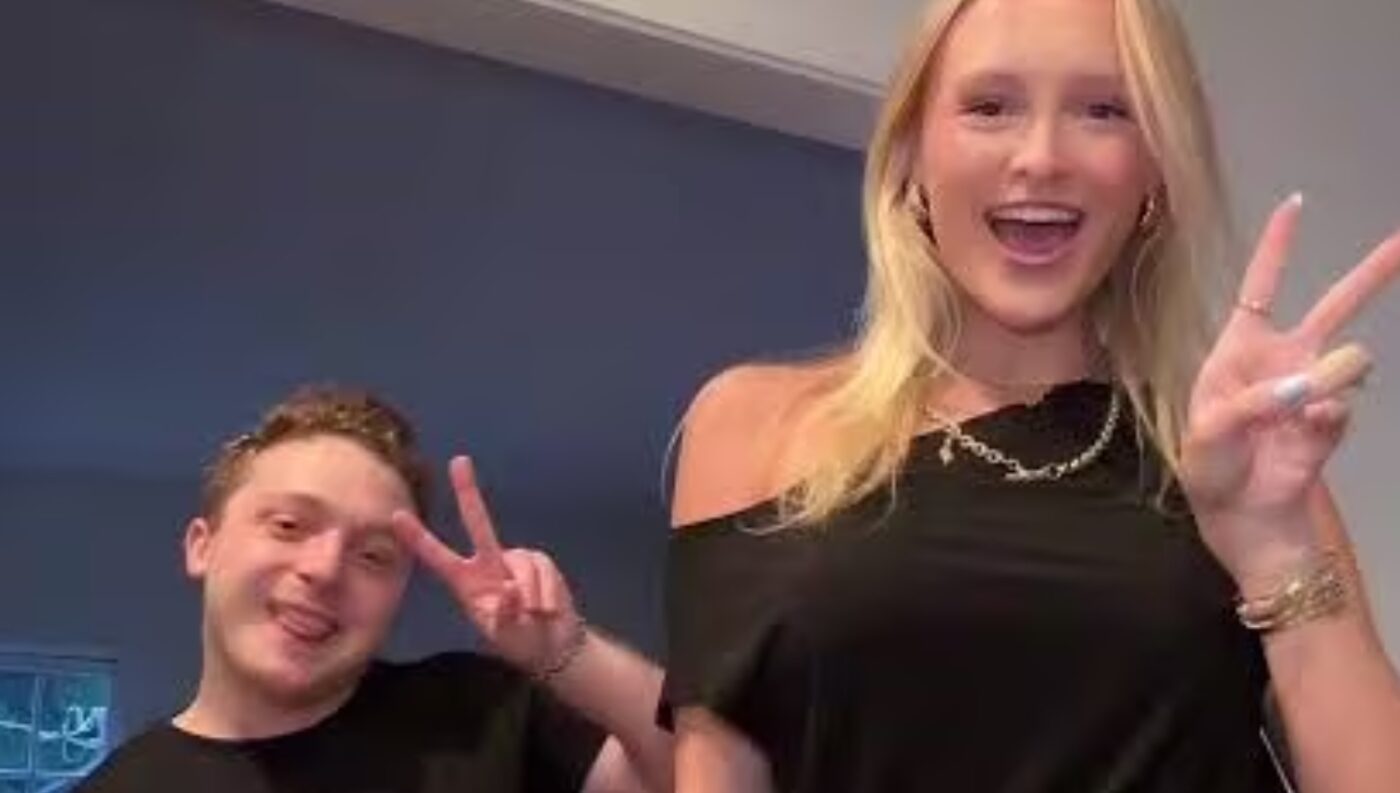
The tight-knit duos and friend groups dominating our feeds are spawning fandoms, inside jokes, and even real-life friendships of their own
When Isabelle Kube, a 29-year-old marketer based in Copenhagen, casually said “That’s common sense, I fear” during a chat at work, she had no idea it would earn her a new friend. The phrase means little to most people, but to a certain corner of the internet, it’s an unmistakable badge of belonging. It traces back to an exchange between influencers and close friends Jake Shane and Brett Chody on Shane’s podcast Therapuss, when Chody, a distance runner, casually informed a stunned Shane that every marathon is the same distance and dropped the now-famous line. The moment took off, becoming a TikTok sound used more than 17,000 times. When Kube uttered it at the office, a colleague instantly clocked the reference, and a friendship was sealed.
“We bonded over the fact that our For You Pages are identical, and that we follow the same people,” Kube says. “Sometimes [when we’re talking], another colleague will be sitting there asking, ‘What are you guys talking about?’, and we’re like, ‘You’re not online enough.'”
Kube is far from alone in her devotion to influencer friendships. As the creator economy keeps expanding, some of the most successful names online come as pairs or crews, letting audiences into the everyday rhythm of their relationships: Dom Roberts and Maya Umemoto Gorman of Upstairs Neighbors, Brooke Averick and Connor Wood of Brooke and Connor Make a Podcast, and Shane and Chody among them. In sharing these bonds publicly, creators develop their own if-you-know-you-know vocabularies that deepen fan loyalty. As the Therapuss line proves, one phrase can become a marker of who’s in the know. Certain duos, like Chody and Shane or Ride’s Benito Skinner and Mary Beth Barone, are followed so intently that fans produce edits of them, much like they once did for beloved on-screen couples. So what explains our fascination with watching these friendships play out?
Kudzi Chikumbu, formerly director of creator community at TikTok and now VP of creator partnerships at Tubi, says the phenomenon isn’t new. “Creator friendships have existed on the internet from the time that I started working on it,” he notes, citing mid-2000s YouTube groups like O2L, which featured Connor Franta and Kian Lawley. TikTok had its own version in the Hype House, home to the D’Amelio sisters, Lil Huddy, and Addison Rae. But today’s viral friendships tend to spotlight friends who became influencers rather than influencers thrown together into a group, which makes them feel more genuine. Chikumbu adds that short-form vertical video pulls viewers directly into creators’ lives, heightening the sense of intimacy. “You almost have this positively parasocial relationship with a friendship as if you’re one of them,” he says. “It’s like you’re getting to eavesdrop on a real friendship, but you’re also part of the friendship.”
Rebecca Jennings, a reporter covering internet culture and the creator economy, sees it the same way. “It’s like this dream friendship where we don’t have to do any of the work, but we get to feel like we’re part of it,” she says. She also suggests that friendship itself has taken on aspirational value in 2026. “Influencers have always been admired for flaunting what they have, and right now, something that a lot of people want and don’t feel they have enough of is friends,” Jennings says. “Fewer people are getting married and fewer people are dating… So instead of being interested in romantic ships, audiences are more interested in these aspirational friendships they’re seeing on their feeds, which they feel like they can root for without it having to be the end-all be-all of their life in the way a romantic ship might be.”
If friendship has become something to aspire to, then fandom built around creator duos can also open the door to real connection, just as it did for Kube and her coworker. The same happened for Anjolie Ware, a college student in Georgia, who grew close to her now-roommate through a shared love of Brooke Averick and Connor Wood. Fandom has long been fertile ground for friendship, but Ware argues the constant access we now have to creators makes it feel entirely different. “[My roommate and I] have a lot of shared interests in music, too,” the 20-year-old says. “But because the influencers are posting content every week, there’s honestly something for us to participate in more often. It’s almost like its own cultural thing that we talk about more day to day.”
Like Kube, Ware jokes that she and her friend now speak a “coded language” drawn from the influencers’ podcast, a stream of internet-isms only fellow fans would understand. Ella Willabrand, a 29-year-old in San Francisco, tells a similar story. She and her now-best friend clicked after both quoting Emergency Intercom, the podcast hosted by Enya Umanzor and Drew Phillips, and realizing they were both fans. Willabrand also follows Upstairs Neighbors and made a new friend at the duo’s live show last year, where the crowd was encouraged to mingle. “It was low-key like a church service,” she says of the evening.
It’s tempting to write off this obsession as excessively parasocial, but the pull may be far simpler: it feels good to belong to something. If a single influencer offers a world to disappear into, a duo or friend group offers something even richer. As Willabrand puts it, “It feels like you’re part of an inside joke alongside thousands of other people.”