

When January rolled around, a wave of young people made a bold promise: 2026 would be the year they stepped away from their screens. Six months later, the real question is whether anyone actually kept that promise.
The urge to unplug has been building for a while. As social media addiction becomes harder to ignore, especially for people whose livelihoods now depend on staying online, more young people are actively fighting back. Tools built to curb screen time, like Brick, One Sec and Freedom, have taken off precisely because so many people feel trapped by their own devices. The desire is simple but urgent: to be present with the people around them, to stop hiding behind a screen when emotions get uncomfortable, and to genuinely experience life again.
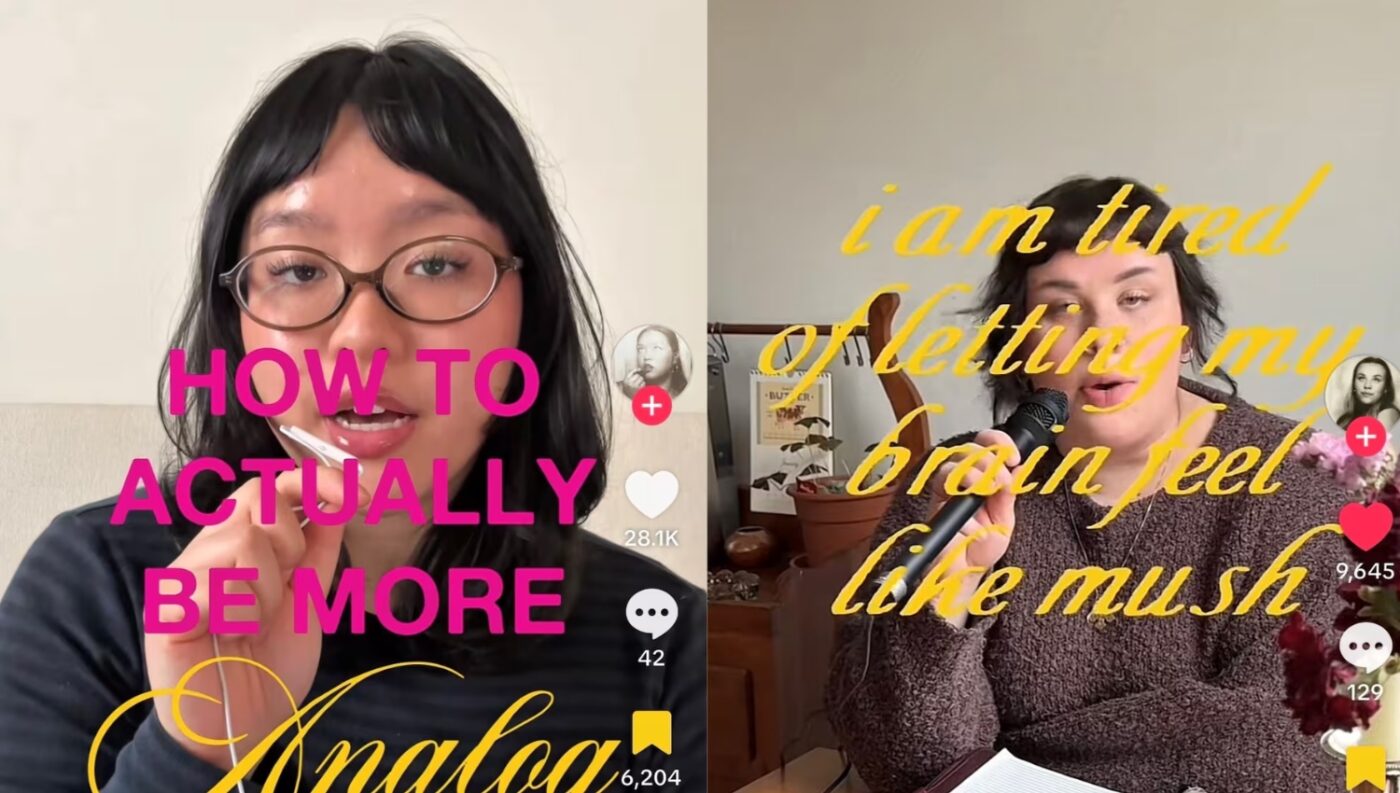
That collective mood crystallised early in the year, when creators began calling 2026 the year of analogue living. The pitch was that a generation raised online was waking up to a hard truth: they own almost nothing. Films, music and media all live behind endless subscriptions. Combined with an increasingly divisive internet, the argument went, people would start gravitating back toward tangible, offline pleasures such as CD players, trips to the cinema and iPods.
Throughout January, hundreds of young people documented their attempts to cut back, watch less television, sit with their boredom instead of reaching for a distraction, and reconnect with friends and family. But now that we’re halfway through the year, the interesting part is seeing who stuck with it. We spoke to three self-described amateur Luddites about how it’s actually going.
Shaughnessy, 26
“I loved learning when I was in school. I thrived in an engaged environment, and once I finished, I started to feel mushy-brained. Watching the direction technology was heading, especially with AI, left me genuinely unhappy.
“One of the first things I did was cancel all my streaming services, which felt great partly because I don’t agree with the politics of the people who own them. A friend sent me a TikTok a while back joking about being ‘a vegetarian plus bacon’, and it clicked for me. I could go analogue in a way that actually suited me. I can make meaningful changes and still watch something like Love Island. An all-or-nothing mindset is honestly so unhealthy.
“The irony isn’t lost on me. TikTok gave me opportunities and connections, but I barely post now because I don’t want to live on the app. Preaching about stepping back while needing the platform to do it is a total oxymoron, and stepping away does mean I’m not growing there. Still, it’s worth it. I’m far less stressed than before, and my daily screen time now sits at 18 minutes.”
Dais, 23
“I started my Becoming Analogue series on TikTok in January, and I’m still analogue in some ways but not others. When I’m busy, it’s easy not to scroll. On freer days, I reach for my phone. I recently got a Brick, which helps me stay present.
“I started because I kept catching myself wasting time. I’d open TikTok for a couple of minutes, look up, and half an hour was gone. That was my actual life slipping past. I create content and work in social media, so my job lives here, but I knew my downtime needed to change.
“It’s been hard but worth it. I’m not anti-social media at all. When it’s good, it’s great, but I couldn’t let it run my life. Getting off the platforms was tough at first, and I’d still call myself chronically online, but instead of four hours a day I’m now on for about 30 minutes, editing and posting included. This was exactly what I needed.”
Brianna, 22
“I went analogue in March, and for me it was never really about screen time. My goal was to live more intentionally and make life as full as possible. I’ve put more energy into the book club I host, gone to the theatre to watch films with friends instead of staying home, taken pottery classes, spent time in the studio, and played board games. That intentional mindset has only grown stronger.
“The easiest and hardest parts go hand in hand. As a homebody, peeling myself off the couch takes real mental effort, and overcoming that is the hardest part. But the easiest part comes the moment I’m out the door. Life is fun, and I genuinely forget that sometimes. I get stuck in a routine of turning down plans, but when I push past it, I always have more fun than I expected.
“Living this way has been incredibly rewarding. I’ve had new experiences, made new friends, and felt more alive, and I’ve used my phone less simply because I’m too busy actually living.”