

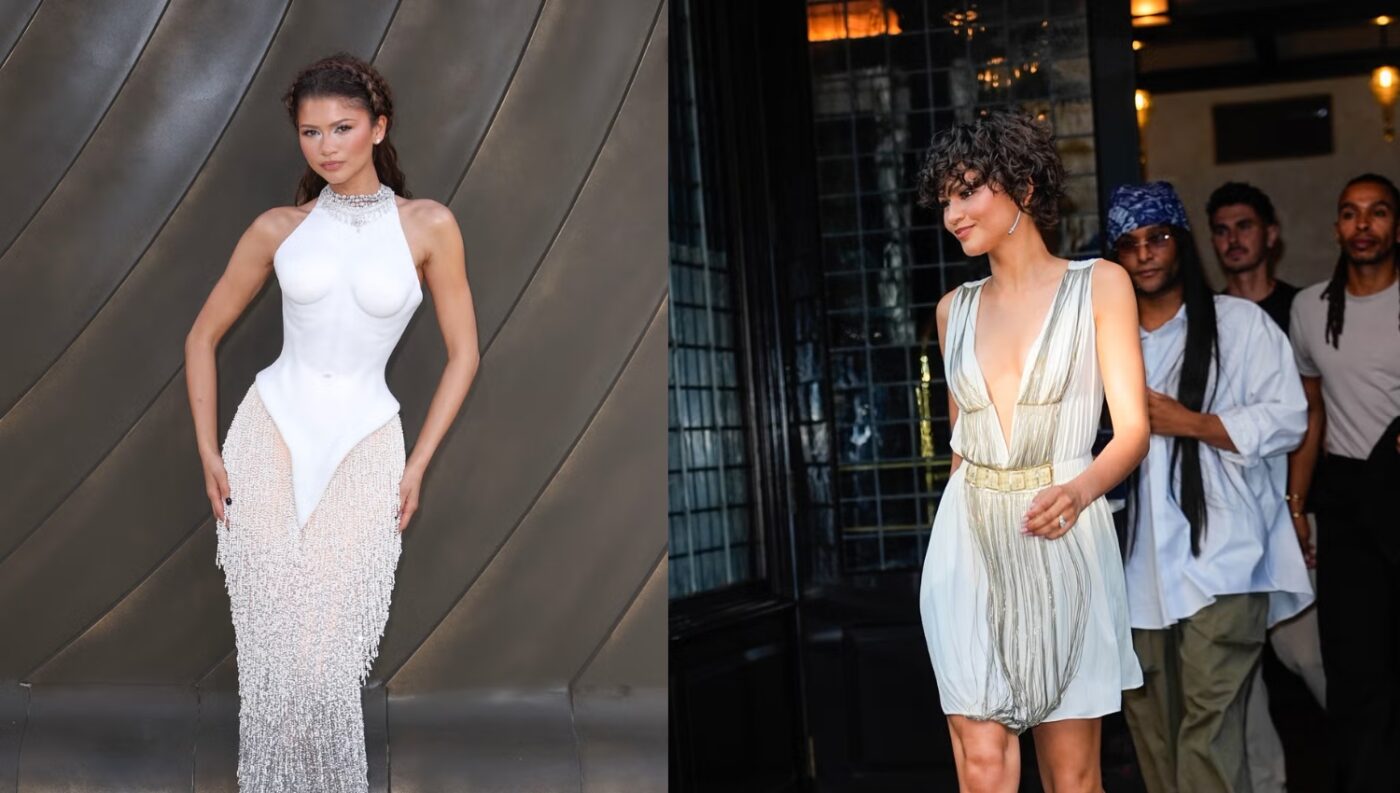
Long before Christopher Nolan’s The Odyssey arrived in theaters this week, the fashion world had already spent more than a hundred years falling in love with ancient Greece. Zendaya’s press tour for the film—she plays Athena, goddess of war and wisdom—leaned hard into the aesthetic, with stylist Law Roach dressing her in flowing drapery, crisp lines, and an almost entirely white wardrobe across premiere after premiere. Her New York look, a draped gown from Matières Fécales fitted with life-size feather wings, echoed the Winged Victory of Samothrace in the Louvre, while her makeup nodded to the myth of Icarus flying too close to the sun.
But those looks are only the latest chapter in a very long story. Neither the poem nor the film pretends to be historically precise—Homer’s epic was composed centuries after its supposed events and populated with monsters—and fashion has taken the same creative liberties for generations. The two foundational garments of ancient Greek dress, the chiton and the peplos, established an ideal of clothing that let the body move freely, unconstrained and largely ungendered. That principle has echoed through modern wardrobes ever since.
Freeing the Body in the Early 1900s
The break from corsetry began in earnest at the start of the twentieth century. Paul Poiret was among the designers who led the charge, drawing on Grecian forms to build loosely draped garments—including a classical dress made for dancer Isadora Duncan in 1906, its waist freed by folds secured with rope-like sashes. Madeleine Vionnet pushed the idea further in the 1920s and ’30s, constructing ethereal dresses from single lengths of fabric with no fastenings, inspired directly by the chiton. Mariano Fortuny, meanwhile, developed his heat-based silk micro-pleating technique for the famous “Delphos” gown, modeled on the Charioteer of Delphi sculpture and worn by socialite Marchesa Casati in 1909.
A Midcentury Revival
After Christian Dior’s restrictive “New Look” reintroduced boning and padding at the end of World War II, a new group of designers set about liberating the female form once more. Madame Grès sculpted Hellenic jersey dresses and micro-pleated gowns that read more like statuary than clothing. Jean Dessès, born to Greek parents in 1904, turned his clients into goddesses with delicate pleatwork. Claire McCardell brought Greek revival to American ready-to-wear with her shapeless, self-tie “Monastic” dress, and Mary McFadden invented her own “Marii” micro-pleat fabric for gowns rooted in the chiton.
Playful Reinvention at Century’s End
By the late twentieth century, designers were treating Classical references with a wink. Norma Kamali’s one-shouldered “Diana” dress, first designed in the 1970s, remains in production today. And Gianni Versace—raised in Reggio Calabria near the ruins of a Greek temple—wove the Medusa head and the Greca motif into his brand’s identity, dressing models as gods and warrior princesses, sometimes with a knowing sense of parody.
Tribute Collections in the 2000s
As runway shows became themed spectacles, designers began referencing the designers who had referenced Greece. Lee McQueen’s 1997 couture debut for Givenchy, “Search for the Golden Fleece,” dressed warrior goddesses in white and gold. Yohji Yamamoto built his Spring 2005 collection around Madame Grès, while Jean Paul Gaultier mashed Greek forms with Parisian archetypes in 2006. Valentino devoted its Spring 2016 couture show to Fortuny, Karl Lagerfeld staged an Acropolis-inspired set at Chanel for Resort 2018, and Dior took its 2022 Cruise show to Athens, reimagining the peplos on modern athletes in sneakers.
Greek Influence Today
Contemporary fashion is harder to pin to any single designer, so the influence now surfaces as sweeping trends. Gladiator sandals—cages of interlocking leather straps—dominated stylish summers throughout the 2010s. Draping has since anchored collections at Loewe, Dior, and Alaïa, and reappeared in Fall 2026 couture at Schiaparelli and Balenciaga. Breastplates, that armor-meets-bodice hybrid, have become a red carpet staple, appearing all over the 2026 Met Gala. Zendaya wore one herself during this press tour—bringing the whole tradition full circle.