

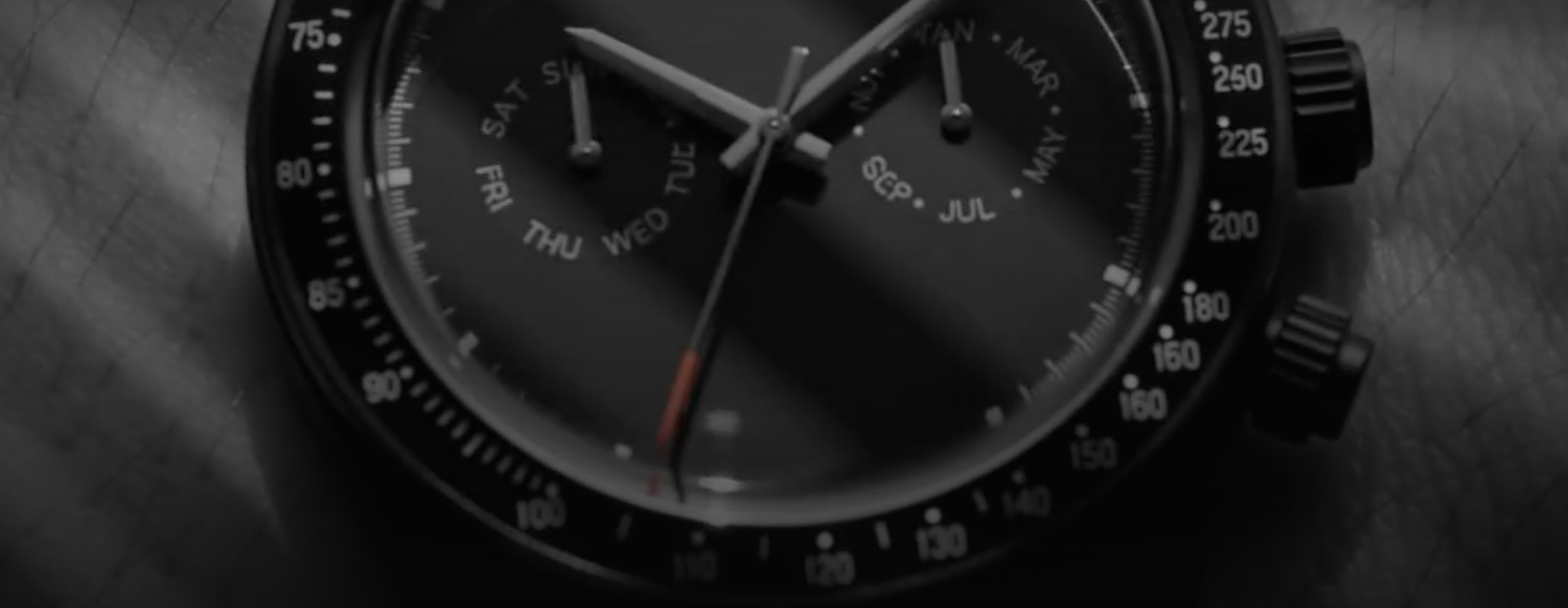
Named for the Isle of Man TT, the mountain circuit where riders survive by refusing to hesitate. Designed to the millimeter: a custom dial they couldn’t buy off the shelf, and a 2 o’clock pusher that isn’t round, which forced Mercier to engineer a welded sheath with its own gasket to keep the case waterproof. Day and month complications, Japan-made automatic movement, domed sapphire crystal, 316L steel case in black PVD. The watch you actually wear, not the one you’re afraid to
There is a particular sadness to a beautiful watch that never leaves its box. The design worked, the object seduced, and then the price of the seduction made the owner afraid of it. Devin Mercier’s design brief for his first watch was written against exactly that outcome.
“Belgian designed, built to be worn out, not put away,” is how Mercier puts it, and the sentence carries the whole philosophy of Mercier Prototype, the brand he founded and designs single-handedly.
Most watches in this category swap a dial pattern onto a stock movement and call it a new watch. We designed the Manx around a custom dial specified to the millimeter, and when that created engineering problems, we solved them instead of compromising the design. Three custom Sellita-based movements are already in development for future releases.
The Belgian design lineage is personal; Mercier is a U.S. veteran with Belgian heritage, and the Manx, available for purchase on Mercier Prototype and his first automatic, reads as European rather than American in its restraint. The retro-racing references, a tachymetre bezel, day and month complications, and a controlled flash of racing red, are handled as accents rather than costume. The watch does not shout its inspiration. It wears it the way good tailoring wears a lining.
It comes in two readings of the same idea. The Noir is blacked out, dial and PVD case in one continuous shadow. The Blanc sets a crisp white dial against the black case, the racing red suddenly legible against it. Same 42mm case, same movement, two entirely different temperaments; Mercier’s bet is that a buyer knows immediately which one is theirs.
The construction argues with the fashion-watch category it might be mistaken for. The case is 316L steel in black PVD, the crystal is domed sapphire, water resistance is 10 ATM, and the caseband is engraved with the specifications: Protoforce, Sapphire Crystal, Stainless Steel, 10 ATM. Inside, an exhibition caseback frames a Japan-made Miyota Cal. 9122 automatic, named openly, chosen for its proven reliability and serviceability rather than for its romantic appeal.
That openness is the design position as much as any curve of the case. Mercier publishes his specifications and names his movement in a market segment that usually sells atmosphere. The object has to survive scrutiny because scrutiny is invited. Each piece is individually numbered and backed by a 5-year warranty, and at $795 the design is priced to be lived in, not preserved.
Design, in Mercier’s telling, is not finished when the watch looks right in the case. It is finished when the owner stops thinking about protecting it: when it goes into the sea on holiday, under a shirt cuff on a workday, and onto the nightstand at the end of both. The domed sapphire and the 10 ATM rating exist so the elegance can be handled.
Most of what you pay for in a well-known watch isn’t the watch. It’s the sponsorship deal, the airport boutique, the celebrity on the billboard, and the layers of distributors that stand between the person who made it and the person who wears it. None of that ends up on your wrist. It ends up in the price.
A small, independent watch company works the other way around. There’s no marketing machine to feed, so the money goes where it should, into the case, the crystal, the movement, and the person you can actually reach.